 Consumer
Penmark
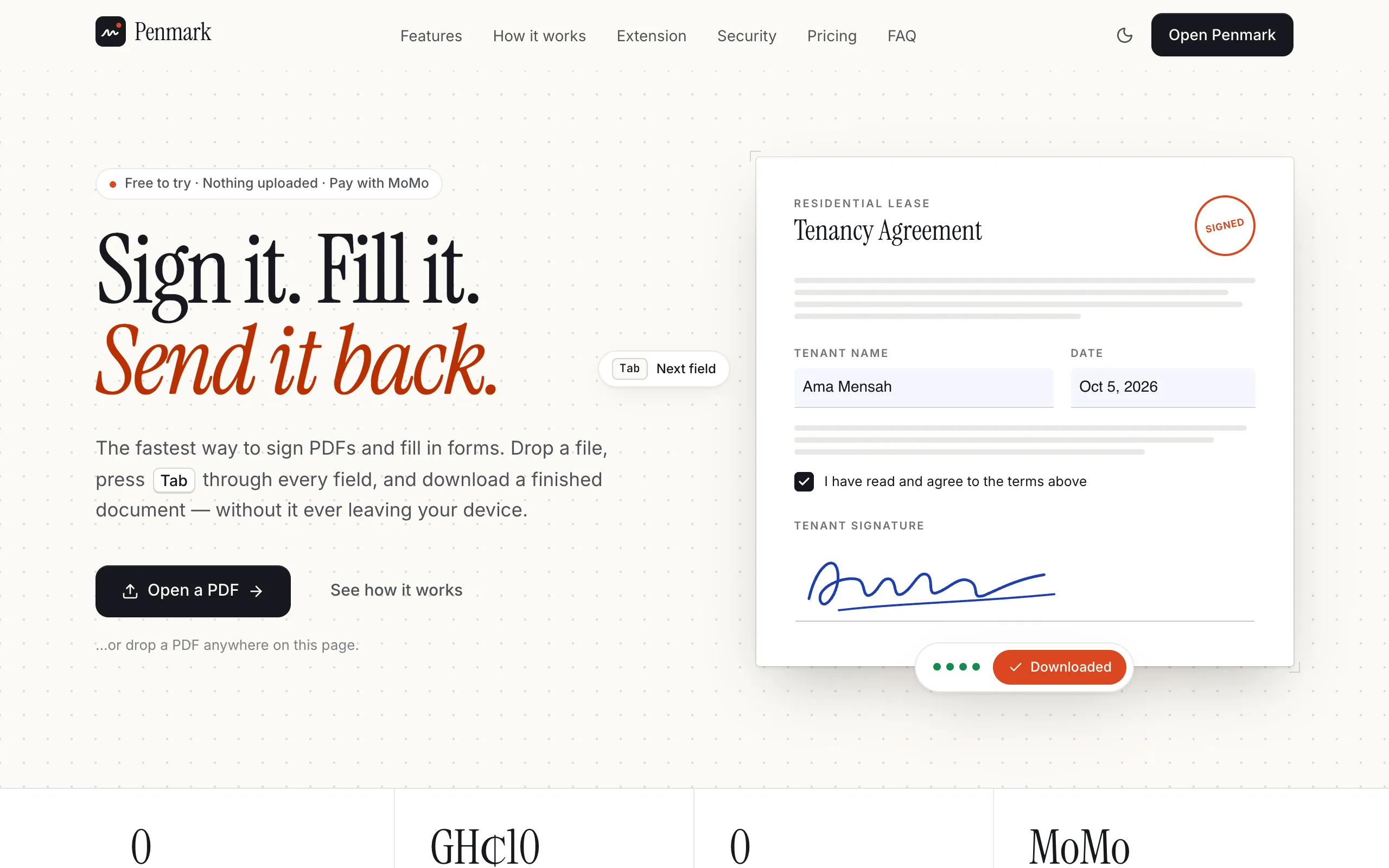
2026 — presentSign PDFs and fill forms in the browser, without uploading the file
LiveTypeScriptNext.js 16React 19+10Open
A church website with the membership admin a Ghanaian congregation actually needs
A congregation carries the administrative load of a small company — membership, groups, events, contributions, communication — with none of the tooling budget and a volunteer doing the work. The public half of this is the easy half: a home page with service times, announcements, a photo and video gallery, and a giving call to action.
The half that earns its keep is the register.
Ghanaian church administration involves collecting and re-collecting the same handful of documents from every member — the national ID card, health insurance, work identification, a passport photograph — and the failure mode is not losing them, it is never knowing who has not handed them over. So the register tracks each member’s set as a checklist, and the admin dashboard leads with what is missing rather than with a count of what is complete. Around it sit the fields that get needed at exactly the wrong moment: next of kin, and a home address recorded as a national digital-address code, which in a country where most homes have no street number is the only form of an address that resolves.
The register searches, filters and exports to CSV, because the person doing this job already has a spreadsheet and will not be argued out of it.
Mobile money is how the congregation gives, and the honest implementation is not a payment integration but instructions: the number, a copy button, the short-code steps to send it, and a warning about the impersonation fraud that follows every published giving number. Nothing is collected by the site — it tells you how to send it, and gets out of the way.
The contact page assumes a first-time visitor without a car: an embedded map, the digital GPS address, driving directions, and what to tell a trotro or taxi driver. That last part is the difference between a directions page written for the people who already know where the church is and one written for the people it is supposedly for.
A prototype: sign-in is mocked and the data lives in the front end, so the register is a working design rather than a system holding anyone’s records. That matters more here than it usually would, because what it is designed to hold — national ID numbers, insurance details, next of kin — is exactly the category of data that needs a real backend, real access control and a considered retention rule before a single member is entered into it.
ConsumerSign PDFs and fill forms in the browser, without uploading the file
An AI secretary and back office for small businesses, multi-tenant from the first row
A barbershop operating system designed around the walk-in queue and mobile money