
 Commerce
TallyhubGH
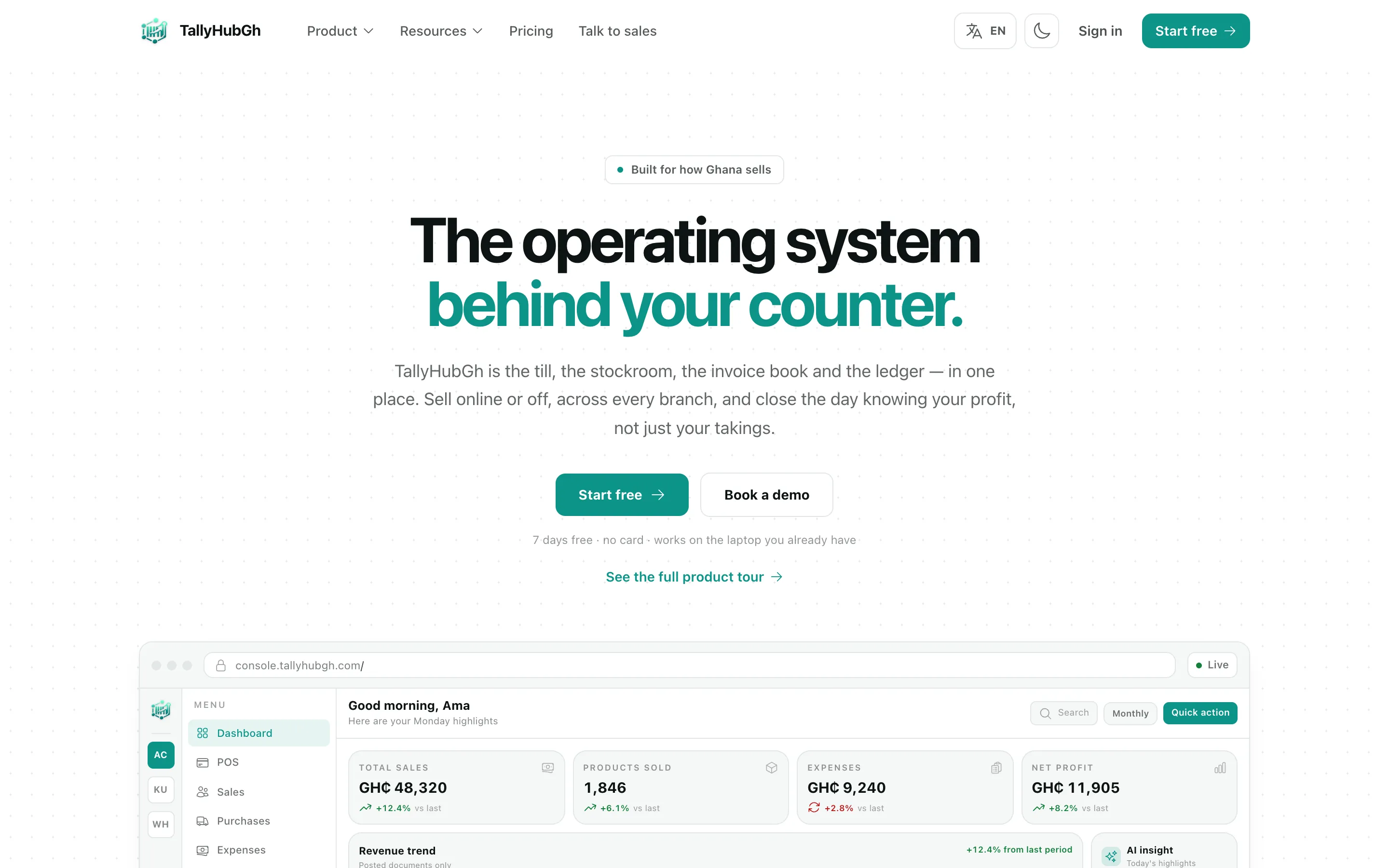
2025 — presentInventory, point of sale and business operations for retail and wholesale
LiveNuxt 3Vue 3TypeScript+14Open
A hair and beauty storefront built for mobile money and mobile data
The live product, running here. Click the window to use it, or open tresoriabeauties.com in a new tab.
Tresoria Beauty sells premium hair extensions, wigs, accessories and care products from Kwamo, in Kumasi. Before this, the shop ran on WhatsApp: photographs sent one at a time, prices negotiated in a thread, delivery quoted after the fact, and orders lost whenever a conversation scrolled away.
The store replaces that with two surfaces out of one codebase — a storefront customers browse and pay on, and a dashboard the owner runs the business from. No developer sits between her and a price change.
Nearly all the traffic is an Android phone on mobile data, and nearly all the money is mobile money. Those two facts decided most of the engineering:
Seventeen admin screens and forty-nine server routes exist for one reason: the shop owner should never need to ask for a deploy. Products and variants, stock levels, categories, discounts, delivery zones, orders through their lifecycle, customer records, reviews and the site’s own copy are all editable from the browser.
Flat colour, real photography, a serif for product names and tabular numerals for prices.
Motion is spring-based rather than eased — drag-dismissible bottom sheets instead of
modals, press feedback on everything tappable, skeletons instead of spinners — and all of
it degrades to plain fades under prefers-reduced-motion.
A single Nuxt application deployed to a VPS behind nginx as a systemd service, built and shipped by GitHub Actions. An Expo companion app shares the same catalogue API.
CommerceInventory, point of sale and business operations for retail and wholesale
Inventory tracking with a scanner in the loop
Table ordering and kitchen flow