 Commerce
Tresoria Beauty
2026 — presentA hair and beauty storefront built for mobile money and mobile data
LiveTypeScriptNuxt 4Nitro+7Open
Inventory, point of sale and business operations for retail and wholesale
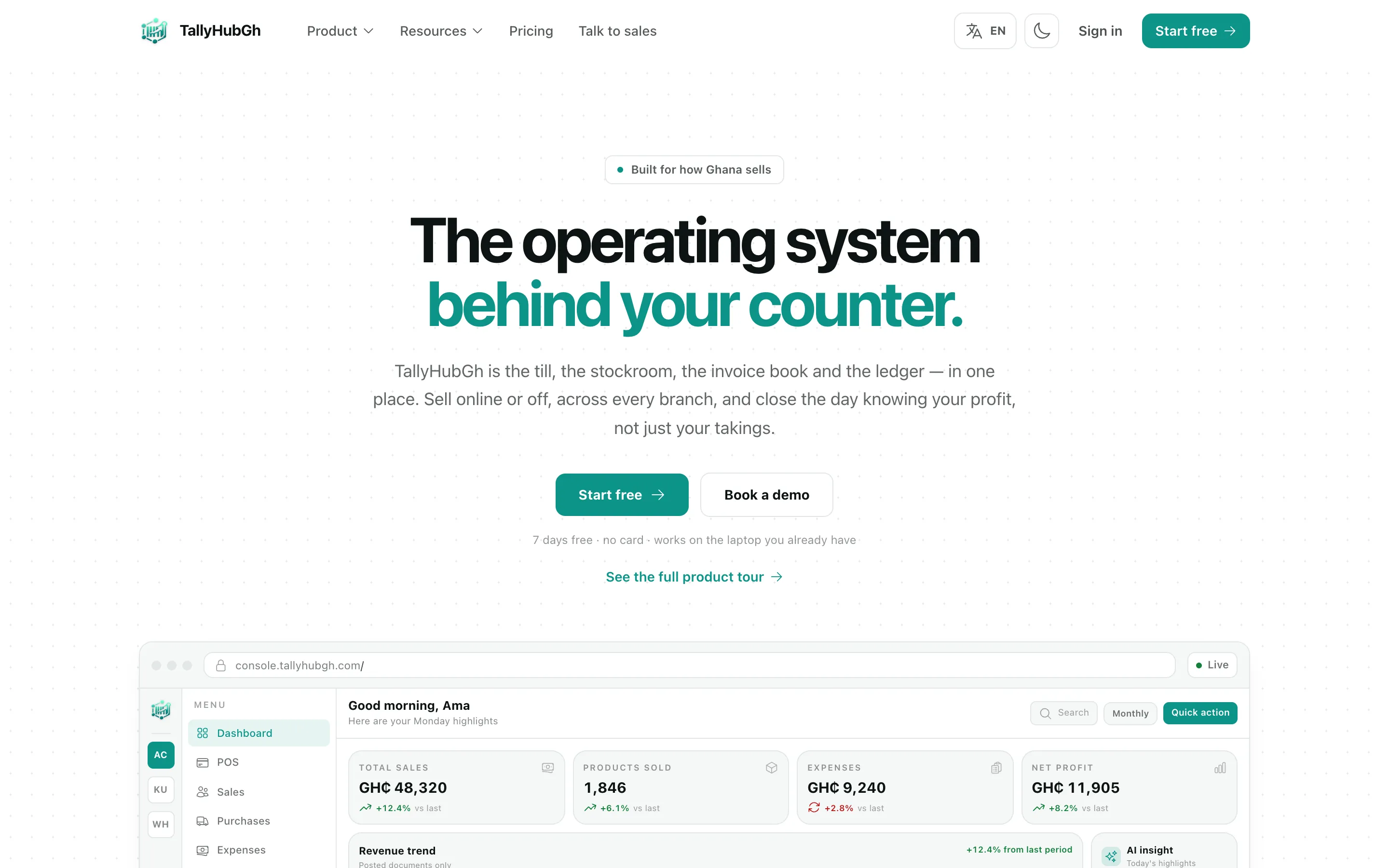
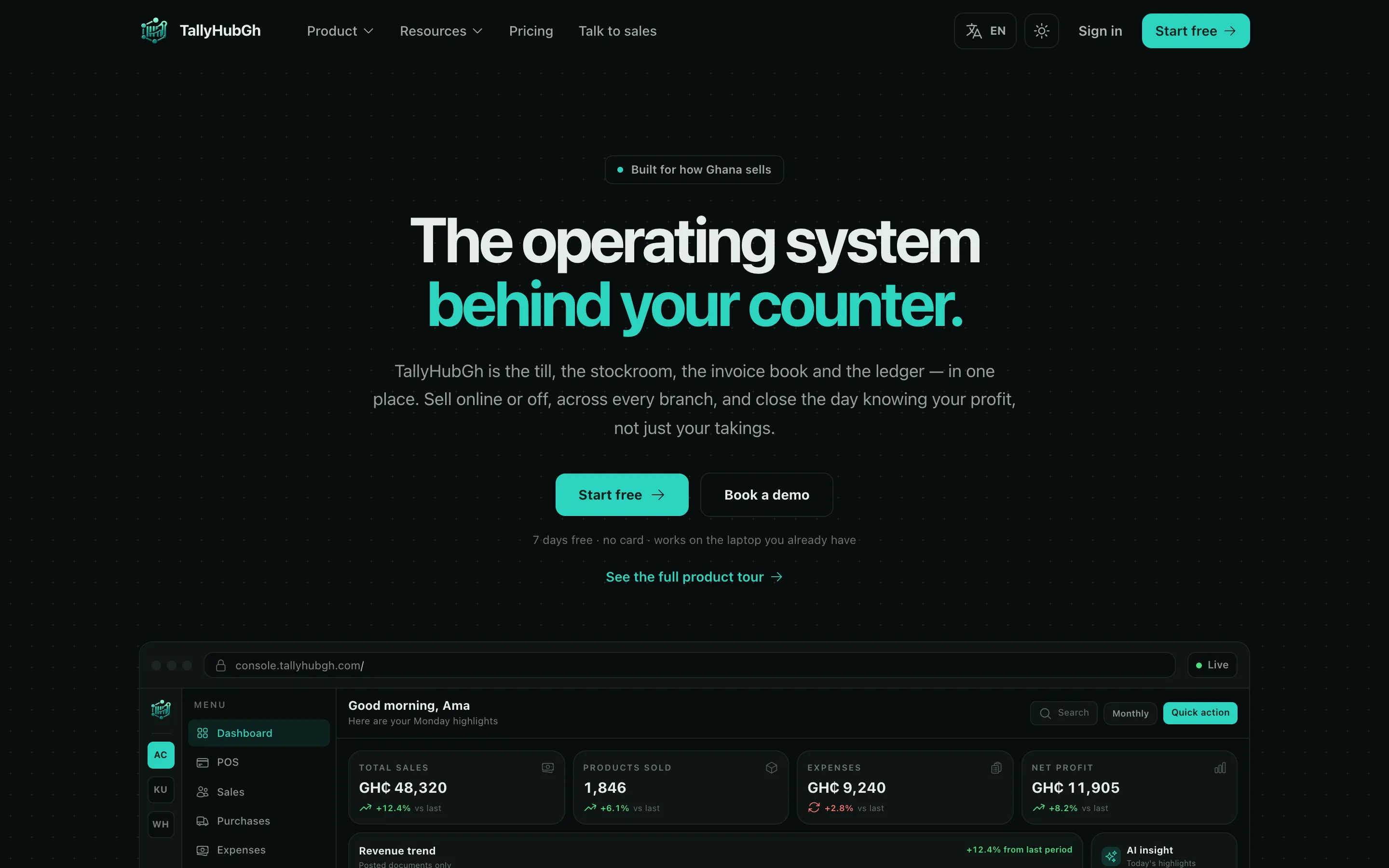
The live product, running here. Click the window to use it, or open tallyhubgh.com in a new tab.
TallyhubGH is the operating system for a trading business, live at tallyhubgh.com. A shop, a wholesaler or a chain of warehouses signs up, loads its catalogue, and gets a till that works on a counter, a stockroom that knows what is actually on the shelf, and a reporting layer that explains where the margin went.
It runs as three products against one data model: the dashboard (the logged-in application), the platform site (marketing, authentication, onboarding, docs and sales booking), and the admin panel (tenant operations, impersonation, plan management). Companion apps cover barcode scanning and customer-facing views.
Most retail software is a CRUD app with a payment button. The difficulty in TallyhubGH sits in four places.
Selling offline. Power and connectivity are not guaranteed where this software is
used. A till that refuses a sale because a request timed out is worse than no till.
So the local database is the source of truth: sales are append-only rows with
client-generated UUIDs, written locally first and replayed to the server through an
idempotent queue. Every record carries a pending | synced | failed status and a
device id, so a retry can never double-charge and a reconciliation pass can always
explain a divergence.
Warehouse scoping. A price, a stock level, a credit limit and a session all belong to a location, not to a tenant. That scoping is enforced in the query layer rather than the interface, because a filter that lives in a component is a filter that will eventually be forgotten. Switching warehouse re-scopes the entire application, including the open POS session.
Two screens, one sale. The cashier drives a dense keyboard-first terminal while
the customer watches a clean read-only display update in real time. Same route, two
roles: state travels over BroadcastChannel when both screens share a browser
profile, and over a WebSocket relay with rooms keyed by tenant and warehouse when they
do not.
Money paths deserve invariants. Refunds, voids, held sales, credit settlements and receipt reprints all mutate ledgers that someone will audit. They are gated behind manager PINs, written with audit trails, and modelled so that a partial failure leaves a recoverable state rather than a wrong number.
The application is a Nuxt 3 SPA over a Nitro server, with Prisma against PostgreSQL in hosted mode and SQLite through the Tauri SQL plugin on the desktop. A platform utilities layer abstracts the difference, so feature code never asks which runtime it is in.
crossws for notifications and the customer display,
with a publisher/subscriber relay so a display can be a separate process or device.TallyhubGH answers questions like “which products lost margin last month?” without sending business data anywhere. A quantized model loads into a web worker through WebLLM, translates the question into a constrained query against a described schema, validates it before execution, and renders the answer as a chart or a summary card. No per-query API cost, no data leaving the device, and it still works offline — which is the whole point.
The installable surface is a Tauri 2 desktop binary for macOS, Windows and Linux — deep-link handling, a draggable native window, custom URL schemes to launch from the web app, and local SQLite. The service worker is unregistered on purpose: offline selling is the local database and the replay queue, not a cached PWA.
@zxing/library, sharing a decoder with the scanner app.The commerce platform on this site has a partner programme. Share a code, and when a referred business subscribes you take 20% of what they pay — 30% from referral 11 onward — every month for 12 months, tracked live.
Free. You get a unique six-character code. You do not need a TallyhubGH subscription of your own.
A link, a QR code, WhatsApp, or the code typed at registration. Sign-ups show on the dashboard immediately.
Commission starts when a referred business subscribes. Cash out to MoMo, a bank or a card, in cedis, through Paystack.
Clients already ask what to use.
You are already installing the hardware.
Stock control comes up in every engagement.
One conversation reaches dozens of traders.
A link, a QR code, and the shops around you.
The shop next door will ask what you run.
partner.tallyhubgh.com
Work it out
Real plan prices. Real rates. Nothing here is rounded up to look better.
One more referral unlocks 30% on everything after
What they subscribe to
What you would earn
GH₵350
every month, once they are all subscribed
GH₵4,200 over the 12 months each one pays
Referrals 1 – 10
Referral 11 and beyond
An estimate, not a promise: you earn on the months a referred business actually pays. A cancel in month three pays you for three months. The rest keep running.
CommerceA hair and beauty storefront built for mobile money and mobile data
Inventory tracking with a scanner in the loop
Table ordering and kitchen flow