 Learning
Solara
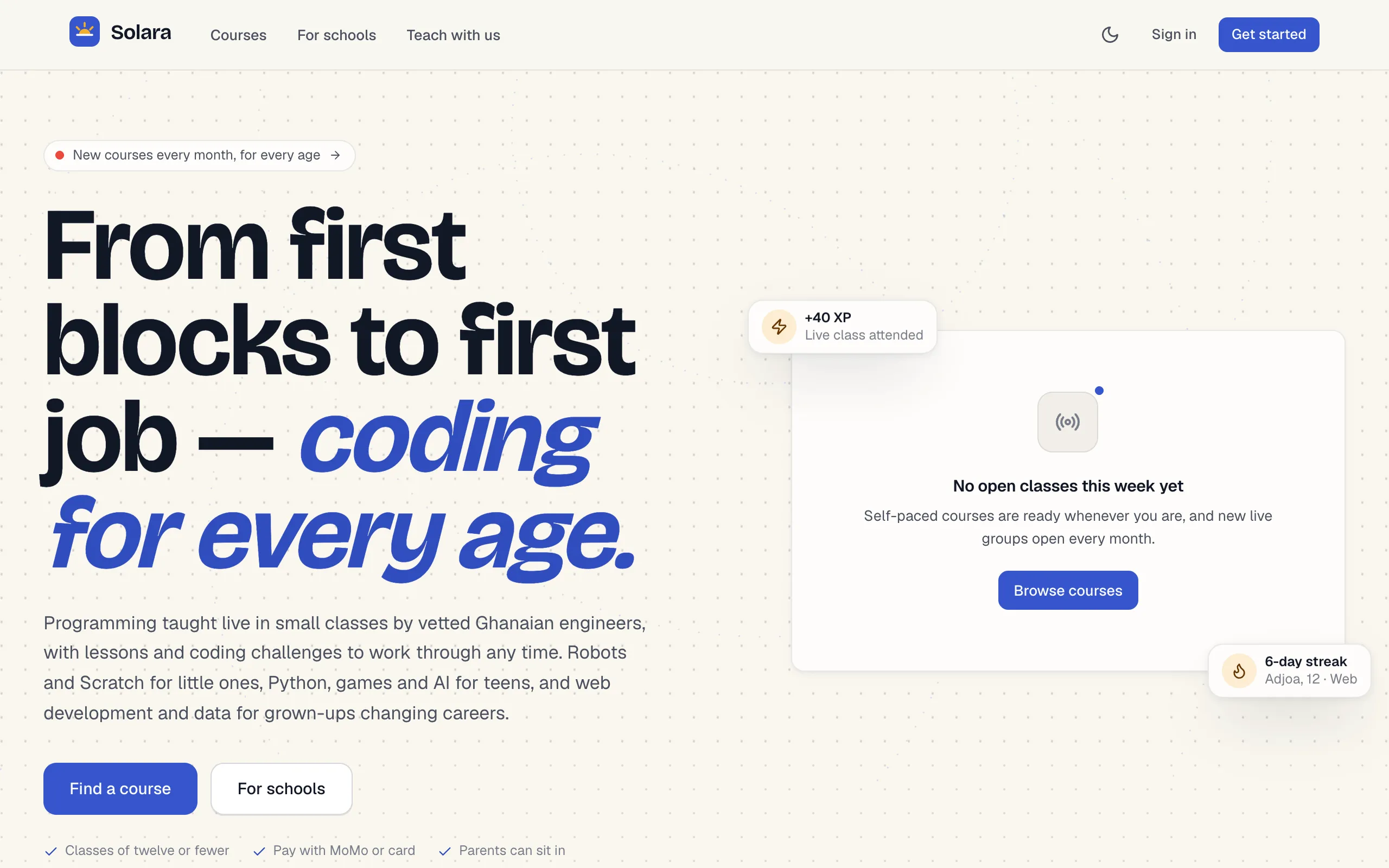
2026 — presentA coding school for every age — live small-group classes, self-paced lessons and certificates
LiveTypeScriptFastifyDrizzle+11Open
The operating system for an institution — admissions through graduation on one platform
What we built
Sample data, real screens. The product itself is atdc.zyntlow.com.
Choose the semester’s courses against the credit window. Prerequisites, clashes on the timetable and fees are checked before the registration goes to the advisor.
Digital Campus is what a university or college runs on, live at dc.zyntlow.com. An applicant applies on a public page. An admissions officer makes an offer. The applicant accepts and the same account becomes a student portal — registration, timetable, attendance, results, transcript. A lecturer teaches in a classroom with materials, assignments, quizzes, discussion and a live room. A finance officer bills and collects. A registrar signs the transcript at the end.
It is built for Ghana first, which shows up in the parts that usually get retrofitted: fees collected by Mobile Money, notices that reach a parent on WhatsApp or SMS rather than only email, certificates that print Ɛ, Ɔ and Ŋ correctly, and an app that still opens when the connection is poor.
Tenancy that does not depend on a careful developer. Each institution lives
at its own address — northridge.campus.example — with its own brand, roles and
data. The isolation is enforced in PostgreSQL by row-level security under a
dedicated database role, not by a where clause someone might forget. A session
cookie belongs to one institution’s address, so an account cannot sign in at
another’s. The front door hands you to your own address with a single-use code
that expires in two minutes.
Permissions an institution can actually explain. A dean sees one faculty, a head of department one department, a lecturer their own classrooms. That comes from one shared permission catalogue and role templates used by both the API and the portal, so a screen and the endpoint behind it can never disagree about who may do what. Everything consequential is written to an audit log.
A classroom that is a real classroom. Live classes run on LiveKit, and attendance comes from its webhook — who was actually in the room, not who clicked a link. Recordings are transcribed, and a summary, study notes and practice questions are drafted from each transcript for the host to share. External tools register over LTI 1.3; SCORM packages play inside a course.
Notices that arrive. Email through Resend, SMS through Hubtel, WhatsApp through Meta’s Cloud API with an approved template, plus Web Push to installed phones. Each institution chooses what it offers and each person chooses what they get. Delivery reports come back by webhook into one delivery log, so “they never got it” is a question with an answer.
A pnpm workspace: a Fastify modular monolith, a React portal, and one shared package holding the permission catalogue, role templates and schemas both sides import.
src/core for database, request context, permissions and audit;
src/modules/* for the 28 domains, from admissions and academics to
procurement, HR and payroll.src/ui is the design system, src/app the shell, and
src/features/* the 54 areas a role can be in.LearningA coding school for every age — live small-group classes, self-paced lessons and certificates
Science practicals in the browser — students handle the apparatus, take their own readings and are marked like WASSCE Paper 3
Automatic marking for multiple-choice papers, entirely in the browser