 Learning
Digital Campus
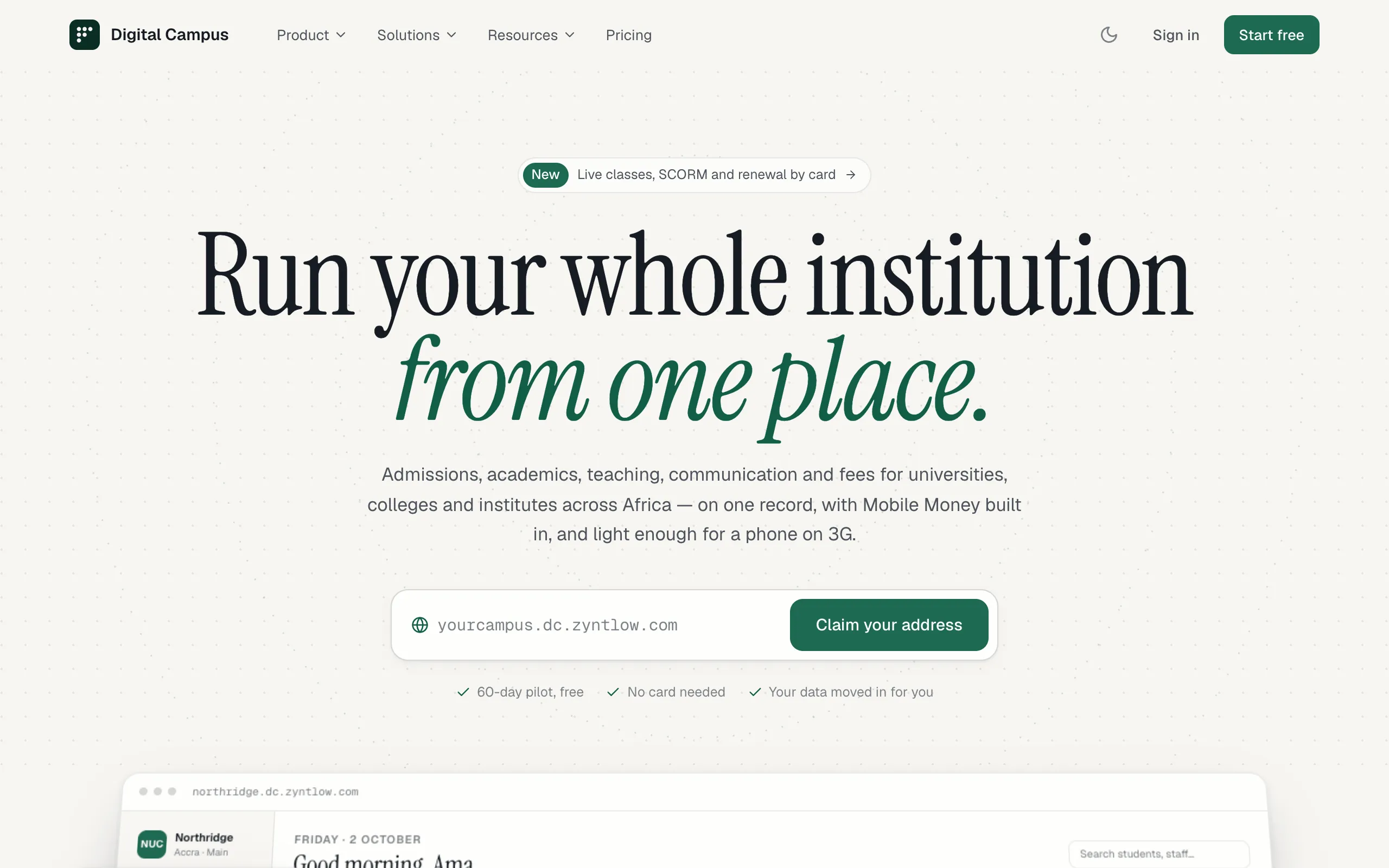
2026 — presentThe operating system for an institution — admissions through graduation on one platform
LiveTypeScriptFastifyReact+15Open
Science practicals in the browser — students handle the apparatus, take their own readings and are marked like WASSCE Paper 3
What we built
Sample data, real screens. The product itself is atlab.zyntlow.com.
A real practical, not a video. Set the thread to 40.0 cm on the metre rule, eye level with the bob, as WASSCE Paper 3 asks.
Virtual Lab is live at lab.zyntlow.com. It is a science laboratory in the browser for Ghanaian JHS and SHS students: a pendulum to time, a burette to read, a circuit to wire. The student does the practical, writes down their own readings, fills in the results table and draws the graph, then hands in.
The governing constraint is that the mark has to be earned on the bench, the way it would be in an examination room. Every practical is marked the way a WAEC examiner marks Paper 3, and from what the student actually did.
Marked from what happened, not what was typed. Every action on the bench is recorded. When a student hands in, the server replays those actions and marks the sheet against them: a written time is checked against what the stopwatch really showed, a swing let go from too wide an angle loses its technique mark, and the value of g has to come from the student’s own line. Each mark carries a reason, and a teacher can scrub through the replay.
A WASSCE syllabus, mapped. There are 51 marked practicals — 24 chemistry, 20 physics and 7 biology — each tied to a topic in the WASSCE syllabus, and 15 also to a GES JHS Science strand. A test fails the build if one is left unmapped.
Glassware without models. The bench is three.js through React Three Fiber, and every piece of apparatus is generated in code, so a practical loads without downloading a single model file.
It goes where the school already is. A host system signs a launch link and shows the lab in a frame, and gets the mark back. Learning platforms that speak LTI 1.3 can launch it and receive grades through Assignment and Grade Services. A school with no system uses the built-in console: classes, a join code and PIN for each student, teachers and the practicals they set.
It is not yet available offline, and biology has fewer practicals than chemistry and physics. A determined student who can read the page’s memory can find their own unknown, so it is a practice and coursework tool, not a high-stakes exam. Teachers can author titrations and qualitative analysis; other kinds still need code.
LearningThe operating system for an institution — admissions through graduation on one platform
 Learning
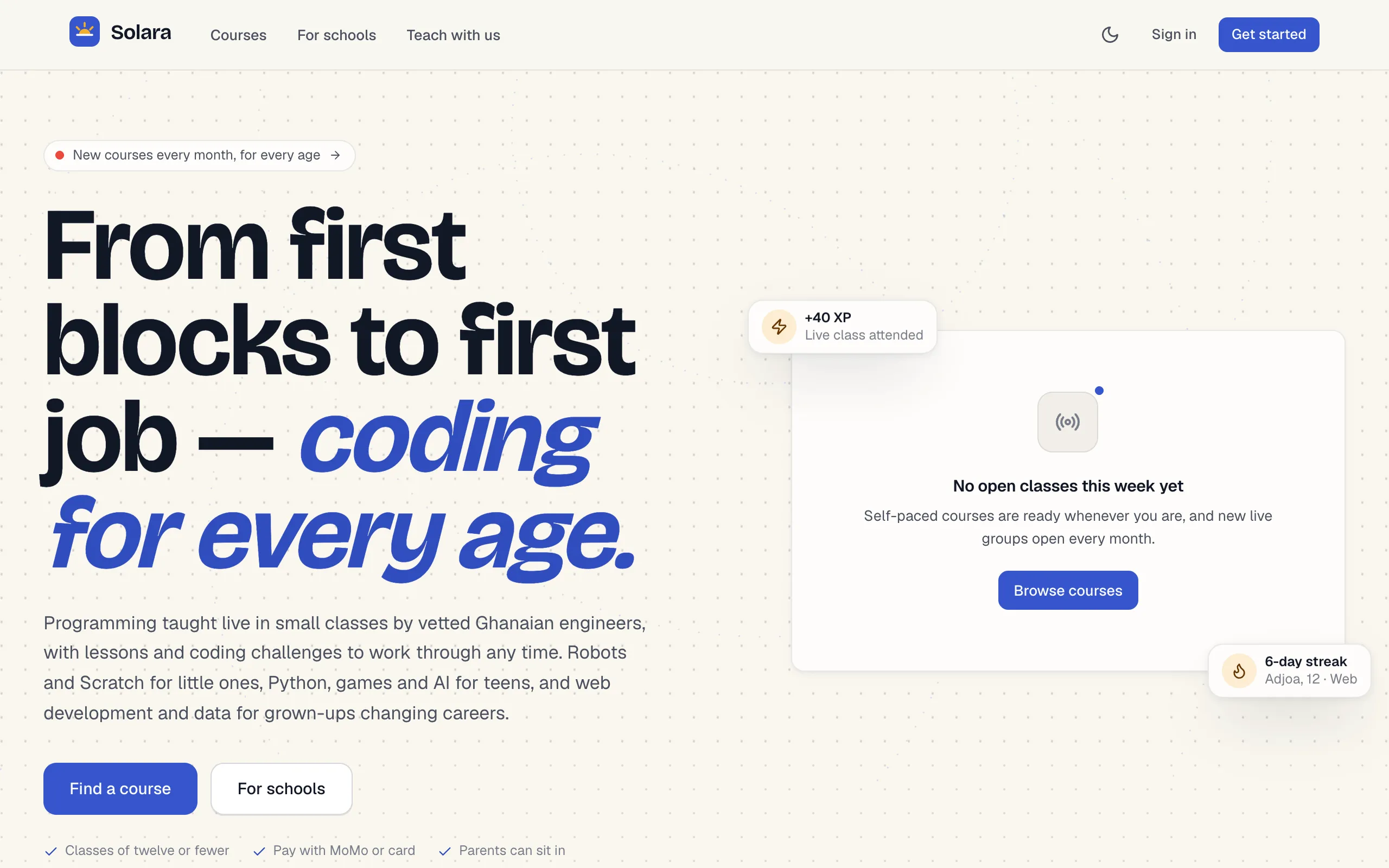
A coding school for every age — live small-group classes, self-paced lessons and certificates
Automatic marking for multiple-choice papers, entirely in the browser