Secret••••••••••Wi-Fi: Harbour-5G · k7#Lm2pQ9x
RevealCopy
Drop a file on one device, pick it up on the other — no app, no account, and big files never touch the server
What we built
Sample data, real screens. The product itself is atferry.zyntlow.com.
Open ferry.zyntlow.com on both devices and type the 6-digit code, or scan the QR. No app, no account, and they stay paired.
Ferry is live at ferry.zyntlow.com. Copying text between an iPhone and a Mac just works; files don’t, unless you email them to yourself or AirDrop cooperates. Ferry is a browser tab on each device: type the 6-digit code from one into the other and they are paired, then anything dropped on one shows up on the other.
The governing constraint is that the server should hold as little as possible. Text and files up to 10 MB are kept for 24 hours so they can be picked up later. Anything bigger is never uploaded at all.
Big files stay where they are. Sharing a large file puts only a placeholder in the space: its name, size and which device has it. The file is kept on the sender, in memory and in the browser’s own storage so a reload doesn’t lose it. When the other device taps Get, the two connect over WebRTC and the file streams across, in 64 KB messages with back-pressure. On the same Wi-Fi it never leaves the room.
A fallback that keeps the promise. Some networks refuse a direct line. Then the receiver opens an ordinary download and the sender pushes the file to the server in 2 MB pieces; each piece is written straight into that download and a piece is not acknowledged until the receiver has taken it. Nothing is written to disk, and an iPhone saves even a huge video without holding it in memory.
Secrets. A password typed with the lock on is masked as it is typed and never saved as a draft. The server records only that a secret exists and when it expires; the text goes device-to-device and never takes the relay. Revealed, it shows for a minute and is destroyed on every device.
Offline. The same server runs on a Mac. The phone scans a QR code and joins over the same Wi-Fi or the iPhone’s hotspot, and files from the phone also land in the Mac’s Downloads folder.
The device that has a big file needs Ferry open until the file is picked up, and iOS pauses a page in the background. There are no accounts, so a space is only as private as its pairing code and its devices.
 Consumer
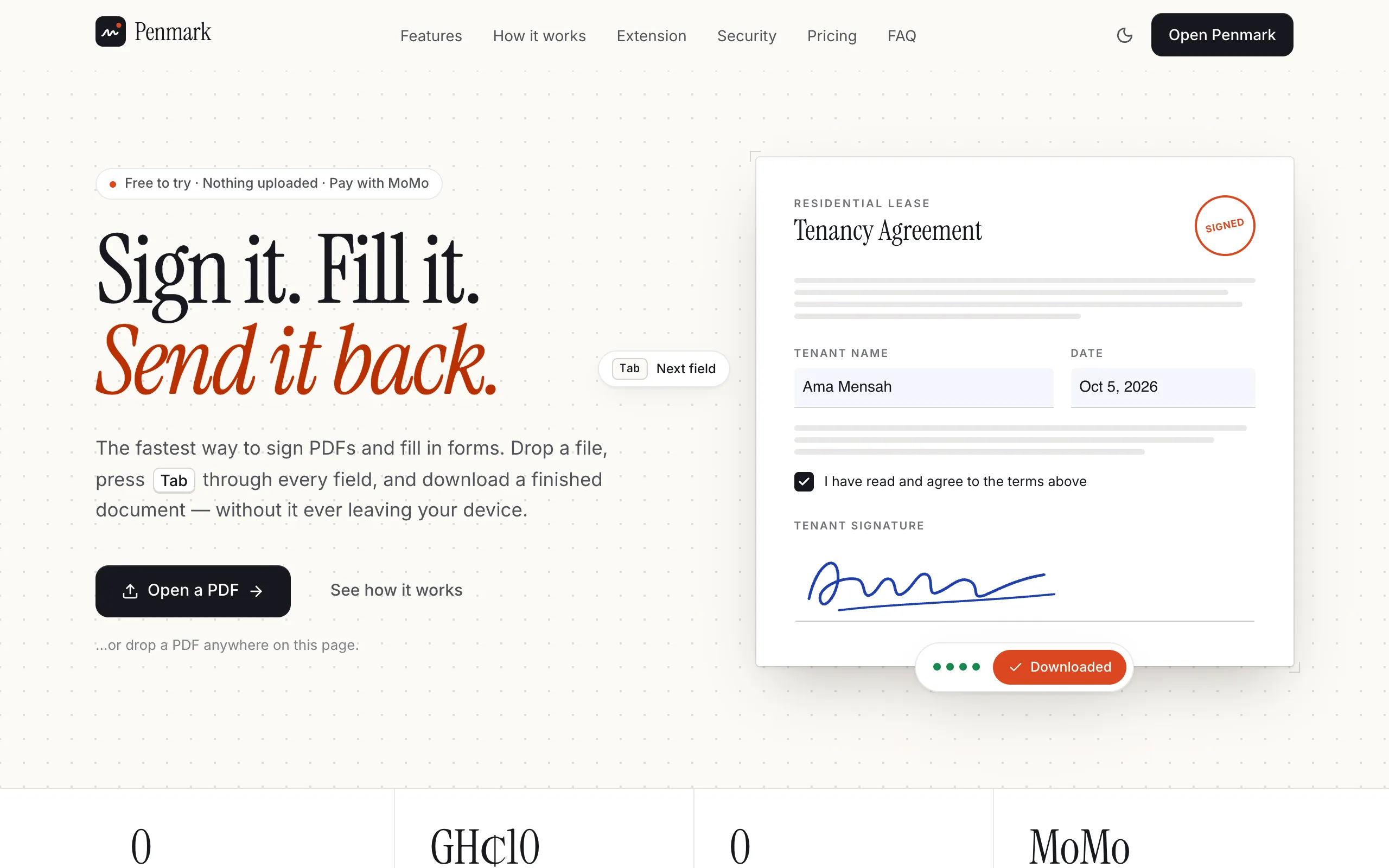
Sign PDFs and fill forms in the browser, without uploading the file
An AI secretary and back office for small businesses, multi-tenant from the first row
A barbershop operating system designed around the walk-in queue and mobile money